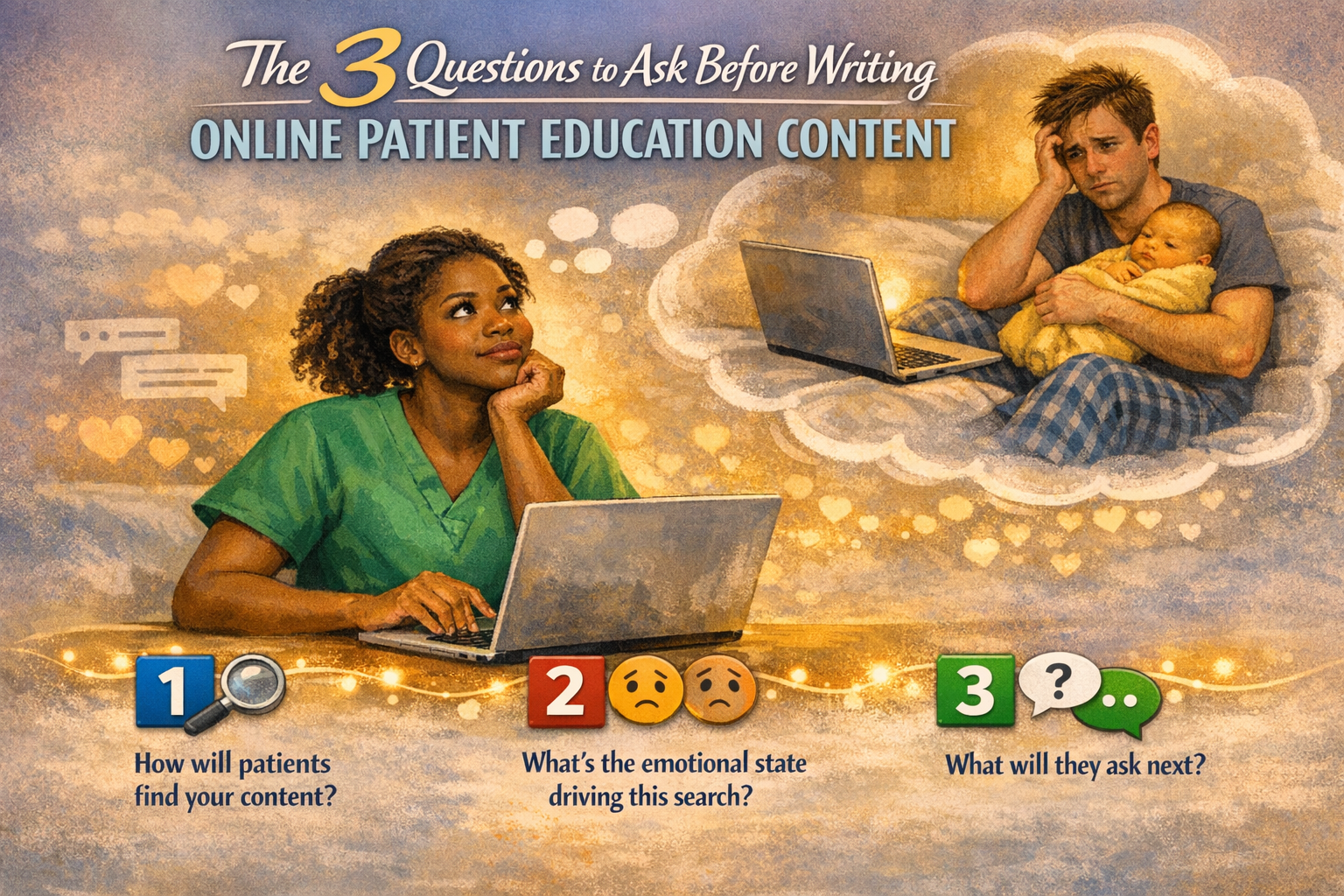
As a healthcare organization, you publish patient education in many forms, and in most of them, a clinician is right there to deliver it, guide it, and answer questions. But online patient education operates differently. It stands alone.
When content is written for internal review rather than patient behavior, it often misses the question patients are asking.
This blog post introduces a three-question framework built around how patients search, what drives that search, and what they will ask next. It shows how healthcare organizations can use this method to create online patient education content that patients find, trust, and return to.
My 22 years as a registered nurse have shown me that the sequence and language of information determine whether patients engage or shut down. That lived bedside experience shaped the three-question framework I use before I begin writing.
When patients find the answer to the question they're actually asking, something subtle but important changes. Trust forms. And that patient who was alone, searching in a desperate time of need, is the one who comes back.
TL;DR: The 3 Questions I Ask Before Writing Online Patient Education Content
In the NICU, when a parent notices their baby's skin turning yellow, my first response isn't full of medical jargon. Before explaining what is happening in their baby's body, I:
Acknowledge what they see
Create space for what they are feeling
Reassure them without assumption
At the bedside, this happens in real time. Online, it doesn't. There is no clinician present to read the room, slow down, and meet patients and their families where they are. This three-question framework brings that same bedside intention to your content.
Before writing online patient education content, I find it helpful to ask:
How will patients find your content? They search in plain language, not medical terminology.
What’s the emotional state driving this search? Fear and worry arrive before the question does.
What will they ask next? Content that follows their natural thought sequence keeps them engaged and coming back.
These three questions shift your content from information delivery to trust-building. That is what turns it into a resource patients seek out again.
Why Patient Education Fails Online (Even When It’s Medically Accurate)
Patient education takes on many forms, including bedside conversations, printed instructions, educational videos, and online materials. But this blog post focuses specifically on online patient education content because it operates differently: it must be found, trusted, and acted on without a clinician present to guide the conversation.
Even medically accurate content can fail when the words on the page don't match the words patients used to find it.
A worried parent types: “my baby’s skin looks yellow”
Without the framework: “Neonatal jaundice occurs when bilirubin accumulates in the bloodstream due to the breakdown of red blood cells, resulting in a yellowing of the skin and sclera.”
This is medically accurate, but the parent just left the page to Google “bilirubin.”
With the framework: “If your baby’s skin looks yellow, it’s something we often see in newborns, and it isn’t caused by anything you’ve done. This is called jaundice.”
That parent feels reassured and keeps reading.
These three questions address that disconnect before a single word is written.
Question 1: How Will Patients Find Your Content?
It's not uncommon for a healthcare organization's content team to ask "What does the patient need to know?" before research on a health topic begins. But when it comes to online patient education, there's another question that's just as important. "What will patients actually search for when they need help?" If the content doesn't speak their language from the very first sentence, they won't stay long enough to find the answer. Trust online is fragile.
Here’s an example from my years in the neonatal intensive care unit. When writing online patient education content about newborn jaundice, a clinician's mind naturally goes to bilirubin levels and phototherapy thresholds. But it's not where a worried parent's mind goes.
Parents aren’t searching for bilirubin or phototherapy. They’re searching in the language of what they see and what scares them: their baby’s skin looks yellow, the whites of their eyes look yellow, or the color seems to be spreading to different parts of their body.
Is this normal? Is my baby okay? What do I need to do right now? From years of hearing these same worries at the bedside, I know this is exactly how parents search when something feels wrong.
The screenshot below shows exactly what that looks like.
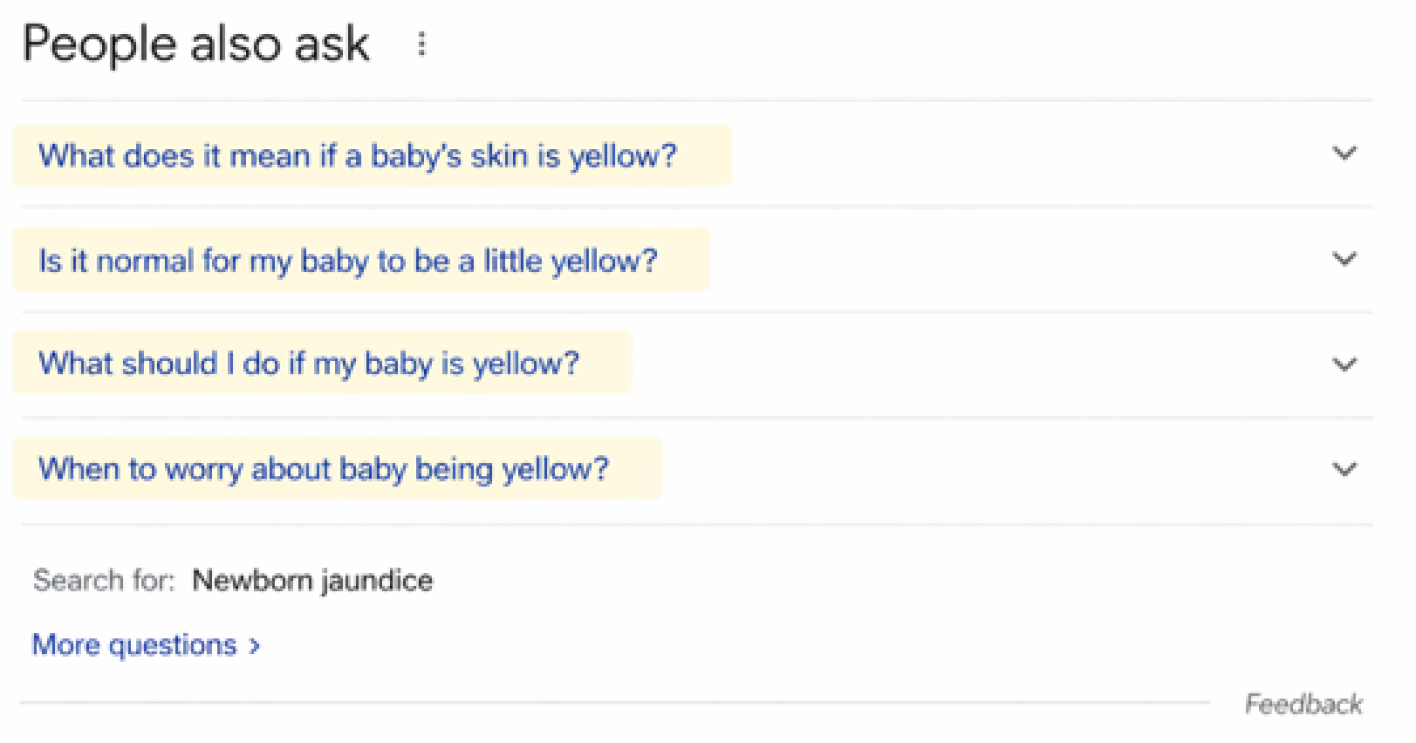
These are the questions parents actually type into Google when something feels wrong. The language is plain, with no medical terms or clinical phrasing. It's simply a worried parent searching to understand what they're seeing. This is where your content strategy begins.
When people search online for help, they use the words they know. Medical terminology is rarely top of mind, especially when fear and stress consume them.
I remember a particular moment when caring for a physician's newborn daughter, who had just received a serious diagnosis. He used medical language every day, but in that moment, it wasn't available to him. I walked him through his daughter’s diagnosis the same way I do at every bedside: in plain language. It reached him in a way medical terminology couldn’t. He thanked me. Not because it was new. Because stress had made it hard to process what he already knew.
That’s what fear does. It strips people down to the basics, even physicians. And when they go online searching for answers, they reach for the simplest words they know, not the ones they learned in training. Your content has to meet them where they are.
But knowing how they search is only part of it. The next question is why.
Question 2: What's the Emotional State Driving this Search?
Knowing what patients are searching for is important, but understanding the emotion underneath the words and phrases they use is just as essential. Worry, confusion, guilt, and fear often show up together.
When a parent types "Why is my newborn turning yellow?" they are trying to understand what they are seeing, whether it needs attention, and most importantly, whether their baby is okay. That emotional weight directly impacts health literacy, and doesn't disappear once they find your content. It shapes how they read, how much they absorb, and whether they trust what they're reading.
Once you understand what they’re searching for and what they’re feeling, you can write a stronger opening. You can acknowledge their concern, offer reassurance, and guide them toward understanding. This aligns with the CDC Clear Communication Index.¹ It emphasizes starting with the audience’s main question and using language they understand, so people can quickly grasp the information and what to do next.
Here’s how these two questions change the opening of patient education content. Below is the same topic presented two ways: first, an opening that leads with clinical facts and ignores how patients search and feel, followed by an opening shaped by Question 1 and Question 2.
Example 1: Leads With Clinical Facts (Misses Question 1 and Question 2)
“Jaundice occurs when bilirubin builds up in a newborn's bloodstream, causing a yellowing of the skin and eyes.”
This opening is medically accurate, but it doesn’t reflect what parents are searching for or what’s driving their concern.
Example 2: Leads With the Patient’s Question and Emotional State (Uses Question 1 and Question 2)
“If you’ve noticed a yellow tint to your baby’s skin and are wondering what this means, you’re asking the same question many parents do. Here’s what’s happening.”
Both openings explain the same condition, but only one immediately reassures them and shows you understand both their question and their concern.
Getting found and keeping them reading is most powerful when your content is ready for where their minds go next.
Question 3: What Will They Ask Next?
Once a patient feels acknowledged, their mind naturally moves forward. Anticipating where it goes next is what keeps them on your page.
Based on my experience, these are the questions parents most often ask when their baby's skin looks yellow. I hear them at the bedside and see them in Google searches. This is the order they naturally follow:
Is my baby ok?
Why is this happening?
Does my baby need treatment?
What does treatment look like?
What do I need to do right now?
This is a psychological order, not a clinical one. One post doesn't have to carry the weight of every patient question. But many posts working together can cover their questions comprehensively.
My From Medical to Meaningful™ framework structures content in that same sequence, and here is what that looks like for a single post on newborn jaundice.
Before and After: From Medical to Meaningful™ framework
This side-by-side view shows how I reorder information to make it easier for patients to follow and act on.
| Clinical Order | Psychological Order (My Method) |
|---|---|
| What is jaundice (medical definition) | Is my baby ok? (addresses fear first) |
| Causes (bilirubin metabolism) | Why is this happening? (builds understanding) |
| Types (physiologic vs pathologic) | Does my baby need treatment? (provides reassurance through clarity) |
| Treatment options (phototherapy protocols) | What does treatment look like? (moves toward action) |
| Call a healthcare professional if: (clinical warning signs) | What do I need to do right now? (drives immediate action) |
When content follows the order patients are already thinking, it keeps them on the page and builds the trust that brings them back.
This framework shapes my own content too. A recent two-word title change in a blog for NICU parents moved from “What You Should Know” to “What NICU Parents Need to Know.” That small shift put Question 1 and Question 2 to work at the same time. “Should know” centers the writer. “Need to know” mirrors the urgency parents already feel.
The Difference Is Where Your Content Begins
This three-question framework changes where online patient education begins. Instead of starting with what healthcare organizations think patients should know, it starts with how patients arrive at your content, what they're carrying emotionally, and the sequence of questions that will unfold.
When content is built from this starting point, patients don't have to work so hard to find clarity or reassurance. These three questions shape what gets included and in what order. That is what makes your content worth finding again.
Work With Me
Online patient education built around how patients search, what they're feeling, and what they'll ask next gets found, trusted, and acted on. I help neonatal, maternal, and women's health organizations get there.
If you’d like to talk about what this could look like for your organization, I’d welcome the conversation.
Email: writer@nayhealthcommunications.com
LinkedIn: linkedin.com/in/luetwintabreedlove
FAQs: How to Improve Your Online Patient Education
1. What makes online patient education content effective?
Plain language that mirrors the words your patients actually search
Answers that lead with emotional reassurance before clinical detail
Visual aids to simplify your content to support comprehension
Content organized around the questions patients ask, in the order they ask them
Medically accurate, evidence-based information with cited sources²
A clear call to action that tells the reader exactly what to do next
2. How is patient education different online versus in clinical settings?
At the bedside, I can read the room, slow down, and check for understanding. I can see when a parent needs more time and give it to them. Online, that's not possible. This content has to stand on its own, ready for someone reading alone who needs answers that feel just as reassuring as having a clinician right there.
3. How do you write patient education content that patients actually read?
Use short sentences (under 15 words), choose common words, and use plain language instead of medical terminology whenever possible.³ Organize content with clear headings, include visuals, write in active voice, and structure information to answer patients' questions in the order they're likely to ask them.
Sources:
Centers for Disease Control and Prevention (U.S.), Office of the Associate Director for Communication. (2019). CDC Clear Communication Index: A tool for developing and assessing CDC public communication products (User guide). Retrieved May 13, 2026.
Brach, C. (Ed.). (2024). AHRQ Health Literacy Universal Precautions Toolkit (3rd ed.). Agency for Healthcare Research and Quality (U.S.). Retrieved May 13, 2026.
National Institutes of Health (U.S.). (2025, February 21). Plain Language at NIH. Retrieved May 13, 2026.